The Harm in Skipping an Oil Change

Serving: Jefferson City, MO

September 10, 2024

Some new vehicle manufacturers are now recommending much higher oil change intervals than they have in the past. As much as 5,000 to 8,000 miles or more. Following these recommendations is very important to avoid engine damage. When you go too long between oil changes, oil starts to turn to sludge. This causes small oil passages to clog and engine parts to fail.


What causes oil sludge? It’s a factor of time and mileage. There are hot spots in every engine that cause oil burn off that leads to sludge. Also, water from normal condensation can build up in the oil. This water also creates sludge. Severe driving conditions lead to more rapid sludge formation.


Severe driving includes short trips under four miles or trips under ten miles in freezing conditions. The engine just doesn’t get warm enough for the water in the oil to evaporate.


Severe conditions are at the heart of the problem. Stop and go driving, towing, dusty conditions, heavy loads, very hot or very cold temperatures, a car top carrier – these are all conditions that would suggest that the severe service schedule should be considered.


The severe service schedule has much shorter oil change intervals. People just need to honestly evaluate how they drive to determine if they should change their oil closer to the severe service schedule, or to the standard schedule.


Some cars give oil change reminders. But it’s important to know how that reminder is determined. For some, the reminder simply comes when the standard mileage interval has rolled around. Others use a computer algorithm that takes into consideration the number of cold starts, trip length, engine temperature and so on. It’s programmed to approximate where on the standard/severe service spectrum you fall. Some more expensive vehicles have sensors that test the cleanliness and effectiveness of the oil.


For the rest of us, better safe than sorry should be the guiding principle. Talk with your service advisor and work it out together. Find out what kind of oil the factory sends out in your vehicle. Sometimes it’s a premium grade that costs more than standard oil – but it may be what’s needed to meet a higher factory recommended interval.

Give us a call.


Read the original article on the NAPA website.

December 15, 2025
We rely on our brakes to safely slow and stop our vehicles. You’ve probably had the experience where you’ve slammed on your brakes and started to skid. When your wheels are locked up, you are just sliding over the road. And if the road is wet or slick or covered with gravel – you really get out of control. Steering is next to impossible. That is why anti-lock brake systems (ABS) were invented: to help you maintain control in extreme stopping conditions. As mentioned, control is lost when your wheels lock up. ABS keeps your brakes from locking – helping you stop while maintaining your ability to steer. Sensors on each wheel equipped with ABS monitor wheel spin and compare it with vehicle speed sensors. When you are pressing on the brakes, still traveling forward but your wheels are not turning, the ABS system steps in and modulates the brakes. They ABS quickly “pumps” the brakes, not allowing the wheels to lock up while still applying braking pressure. This is all done automatically without any intervention on your part. You will feel a pulsation through the brake pedal and will hear a clunking as the brakes are rapidly being applied and released over and over again. The first time this happens to you, you may be surprised and think something is wrong. Well, it isn’t – so just keep your foot on the brake and allow the ABS to do its thing. In fact, remember the 3 S’s of anti-lock brakes: Stomp, Stay and Steer. Stomp on the brakes, stay on the pedal and steer as needed. When you first start your vehicle, the ABS does a quick self-check to make sure everything is OK. The ABS warning light will briefly illuminate with all of the other warning lights on your dashboard and then go out. If the system detects a fault, the ABS light will come on and stay on. Definitely take your vehicle to Frosty Auto Clinic for a check if the ABS warning light is on. Proper brake system service from Frosty Auto Clinic is the best way to protect your ABS. Replacing brake fluid that is depleted and/or contaminated will help preserve proper ABS operation and protect it against corrosion. Ask your Frosty Auto Clinic service advisor if it’s time for a braking system inspection or service.
December 8, 2025
An oil change: Sounds simple, but there’s some important things to know about preventing oil sludge. Oil eventually starts to turn into jelly. Literally – petroleum jelly. Sludge clogs up oil passages and keeps oil from getting to some areas of the engine, causing parts to wear out prematurely. And that means expensive engine repairs. That’s why you need to change the oil and oil filter on schedule – to get the old oil out before it turns to sludge. Your manufacturer will have a recommendation for how many miles you can go between oil changes. They also usually have several months between recommended oil changes. That’s because the detergents and other additives in the oil break down over time. Your owner’s manual will have a recommendation for time and mileage, but you need to remember that it’s based on using the recommended weight of oil. And if your vehicle came from the factory with synthetic oil, the recommended intervals assume you continue to use synthetic. Also, how you drive can have a big effect. Most owner’s manuals will have a list of driving conditions that are harder on your vehicle. Things like stop and go driving, short trips, driving in very hot or very cold weather, heavy loads and towing. If some of your driving fits this, you may need to change your oil and do other maintenance on a shorter schedule. This may sound complicated. Some vehicles have an oil life calculator that takes all these factors into account and tells you when you should change your oil. Otherwise, talk with your service advisor about how you drive and get her recommendation for when to take care of your service. Finally, if any of the steering or suspension parts can be lubed, your technician will take care of that with a lube, oil and filter service. Give us a call.
November 18, 2025
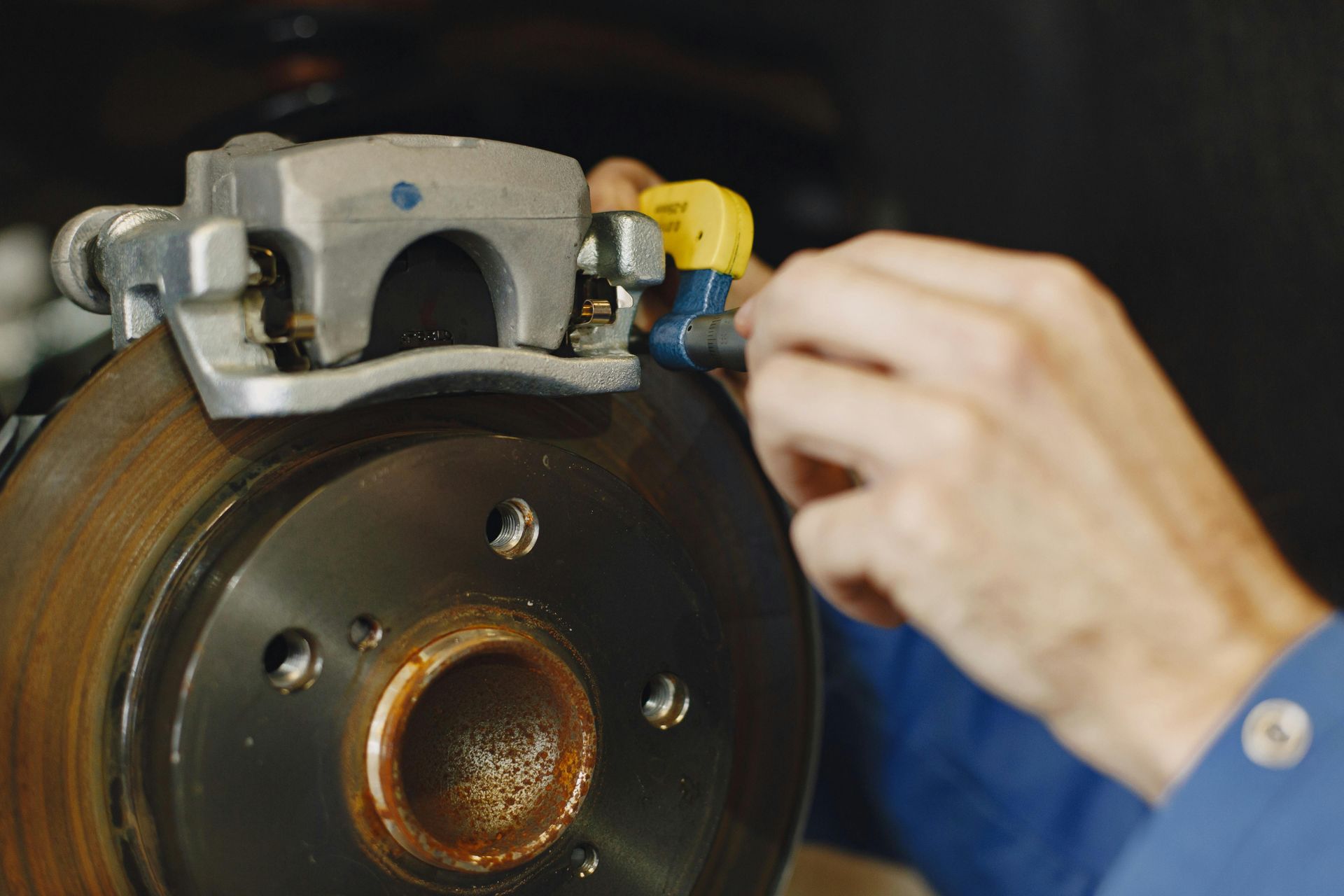
Your vehicle weighs several thousand pounds and it takes a lot of force to bring it and your passengers to a safe stop – so everything needs to be in good working order. The wheel hub keeps your wheel attached the vehicle. The brake disc – or rotor – is attached to the hub and spins with the wheel as you drive. Your brake pads clamp onto the rotor to slow the wheel. The brake caliper straddles the rotor and squeezes the rotor to slow it down. The calipers contain brake pads which rub on the rotor when you step on the brakes. The brake piston causes the calipers to squeeze and release as you use your brakes. Your brake pads start to wear the first time you step on the brakes. Eventually the pads are worn out and need to be replaced. If you don’t replace the pads when they’re worn out, the metal parts of the brake will grind against the rotor and carve grooves into the surface. If a scored rotor isn’t too bad, your technician can put the rotor on a lathe and smooth it out. If the grooves are too deep, or if the rotor is warped or cracked, you need to be replaced it. Servicing disc brakes require special attention to the mechanical sliding and mounting portions of the system. Your service supplier knows the special needs. Sometimes brake pistons can stick and must be replaced. Typically, it’s cheaper to replace the entire caliper than to rebuild the piston. So, there you have it – an inside look at how your disc brakes work. Replacing your brake pads on time will not only keep your vehicle stopping safely but could save you money on unnecessary brake repairs down the road. Give us a call. Read the original article on the NAPA website.
November 4, 2025
It’s easy to forget about servicing your transmission because it doesn’t need it very often, but proper transmission service keeps your vehicle running smoothly and helps you avoid costly repairs down the road. The transmission undergoes a lot of stress. The grit you see in used fluid is actually bits of clutch material. This grit flowing through your transmission under pressure eats away at seals and gaskets which can lead to leaks. The transmission operates at very high temperatures – much higher than engine temperatures. Those high temperatures eventually cause the transmission fluid to start to break down and loose efficiency. At best, your transmission won’t operate smoothly. At worse, it could lead to costly damage. When your transmission’s running properly, it transfers more power from your engine to the drive wheels and improves fuel economy. That’s why manufacturers have recommended changing your transmission fluid at regular intervals. Your owner’s manual has a schedule for transmission service and, of course, your Frosty Auto Clinic service advisor can tell you what the manufacturer recommends. At Frosty Auto Clinic, we may be able to perform a transmission service while you wait and the cost is quite reasonable. Actually, it’s downright cheap when you think about how much a major transmission repair can cost! Give us a call.
October 23, 2025
When your vehicle doesn't start, the first thing you think of might be the battery. That may be the culprit, but it also might be that your alternator has gone bad. An alternator sends power to your vehicle's electrical systems and accessories like your entertainment system, charging ports, and so on. Any extra electricity goes to re-charge the battery. So, your battery is what gets your engine started, but once the engine's running, your alternator is what's turning out the power. A failing alternator may not be able to keep the battery charged. One of the most common causes of an alternator's demise is the bearings fail and seize up. That can happen from dirt and liquid getting into the bearings combined with the heat of the engine. You might hear a grinding sound, an early warning that something's wrong. Other signs your alternator may be failing? A squealing noise in your engine, or your headlights dimming when engine RPMs drop. You may notice an electrical smell coming from the engine. If any of these are happening, you'll want to have your vehicle checked at your NAPA AutoCare Center. Many modern alternators have a decoupler pulley that allows the alternator to rest when it isn’t needed. This extends alternator life and helps with fuel economy. A bad decouple pulley could cause your battery to go dead. If your alternator needs to be replaced, you should also replace the serpentine belt that turns it, and the belt tensioner as well. As you can imagine, if the alternator isn’t rotating as it should, the belt that turns it won't freely move, and that can cause excessive belt wear. The service advisor at your NAPA AutoCare Center will recommend the right replacement parts based on your vehicle's needs and your driving habits. And remember, if you notice any of those warning signs that the alternator might be going bad, it's always better to have it checked out, so you don't find yourself stranded on the road. Contact us today! Read the original article on the NAPA website.
October 15, 2025
The thermostat is part of your cooling system. JEFFERSON CITY residents' vehicle thermostats perform a similar function to the thermostats in their homes. At home, you set your thermostat to maintain a comfortable temperature range. When your home gets too hot, the air conditioning kicks on and when it gets too cool, the heater turns on. Now your engine also has an optimal temperature range: warm enough to run efficiently and not so hot as to cause engine damage. Your vehicle's thermostat is a valve between the engine and the radiator. When JEFFERSON CITY residents first start a cold engine, the valve (thermostat) is closed, allowing the coolant surrounding the engine to warm up to the proper operating temperature. As the coolant gets hotter, the thermostat opens, allowing coolant to flow through to the radiator to be cooled. The thermostat opens and closes to keep the engine within a certain temperature range. Now thermostats are rated for a specific temperature depending on the engine – not a one size fits all proposition. Thermostats are subject to normal wear. Proper operation depends on a special wax that expands as it heats up to open a spring-loaded valve. A worn thermostat could stick in the open position causing the engine to run too cool. This is inefficient and could affect performance and fuel economy. If a thermostat sticks in the closed position, the engine can be subject to the results of overheating. There isn't a specific routine for JEFFERSON CITY residents to maintain their thermostat, but maintaining the cooling system by changing the coolant/antifreeze on schedule will make sure the coolant has enough corrosion inhibitors to protect the thermostat and other system components. Cooling system experts and the team at Frosty Auto Clinic in JEFFERSON CITY recommend replacing your thermostat when you do a coolant flush or exchange. Also, thermostats usually wear out faster than your hoses, so if a worn hose replacement is performed, replace the thermostat at the same time. If your temperature warning light comes on, have an inspection of your cooling system right away. This could be a thermostat . The thermostat could also be the culprit for JEFFERSON CITY residents who aren't getting hot air when they turn on their heater. The thermostat is a relatively inexpensive part that stands guard between you and catastrophic engine damage. Follow your owner's manual instructions, or check with your friendly and knowledgeable Frosty Auto Clinic service advisor to see if it's time for a cooling system inspection or service. Give us a call. Read the original article on the NAPA website.
September 22, 2025
A lot of people in MO have older vehicles. They're good commuters, grocery-getters or toy-haulers. They enjoy that fact that they're paid off, or soon will be. They would gladly like to keep their vehicles for 200,000 miles/320,000 kilometers or more – as long as it's economical to do so. There are plenty of people in JEFFERSON CITY whose vehicles are running after 150,000 or 200,000 miles (240,000 or 320,000 kilometers). We can learn from what they're doing to keep our own cars on the road. A common denominator is that they never skip an oil change. That may sound a bit unsophisticated, but it's really not. First off, oil is the life blood of your engine and it needs to be clean to properly lubricate. Skipping oil changes leads to clogged oil filters and sludge that can damage your engine. Enough said. There's another reason the scheduled oil change is so important. It's simple — a Frosty Auto Clinic professional is going to be looking at your car. All of your fluid levels will be inspected and topped off so they won't get so low that damage can be done. If there is a significant fluid loss — let's use brake fluid as an example — your JEFFERSON CITY technician can look for the cause of the loss and find the problem before it leads to an accident or costly repair. Your JEFFERSON CITY service technician will also visually inspect the vehicle for worn belts and hoses, uneven tire wear, leaking shock absorbers and more. Problems get addressed before they lead to repairs that cost more than the car's worth. And your JEFFERSON CITY service advisor will be able to remind you of other services that the factory recommends you get done. Just think of that oil change the same way as you do about going to the dentist for your six month cleaning and checkup. Don't skip it. Of course, good maintenance costs money, but it's far cheaper than new car payments. Give us a call to schedule your next oil change today. You can find us online at Frosty Auto Clinic, or you can find us in JEFFERSON CITY, MO 65101, at 310 VETERANS LN. Or simply give us a call at 573-635-1767. Read the original article on the NAPA website.
September 15, 2025
Most in the area may not know much about transfer cases, but if you have a four-wheel drive vehicle, you've got one. It makes sure you have power available for both the front and rear axles when driving around MO. For example, if you have a rear-wheel drive SUV, power goes to the rear wheels until you need four-wheel drive. That's when the transfer case steps in and transfers some of the power to the front wheels as well. You might use a shift lever to go into four-wheel drive, it could be a button on the dash or it might even go into four-wheel drive automatically, depending on your vehicle. The transfer case is serviced at Frosty Auto Clinic by periodically draining its fluid and replacing it with fresh fluid. We also check for leaks and damage. Transfer case fluid cools and lubricates the gears, chains, bearings, shafts and other parts for JEFFERSON CITY motorists. Over time, the additives in the fluid wear out and it doesn't protect as well. Also, bits of metal and clutch material wear off and contaminate the fluid. There isn't a filter in the transfer case, so if JEFFERSON CITY drivers allow the contamination to stay for too long, it'll further accelerate wear. Now, your owner's manual may not have a recommended interval for when you should change your transfer case fluid – so ask your JEFFERSON CITY service advisor at Frosty Auto Clinic. There are several things that affect how often you should change the fluid, so tell her how often you use four-wheel drive: if you drive in wet JEFFERSON CITY environments like places you cross streams or drive through mud and snow. That kind of stuff really shortens the drain interval. Transfer case parts will eventually wear out and you'll have to make repairs. But properly servicing your transfer case at Frosty Auto Clinic will keep that day as far in the future as possible. Call us today. Read the original article on the NAPA website.
September 5, 2025
A driver recently noticed that her garage had begun to smell like gasoline after she parked her vehicle inside. Her Check Engine light had also just come on. This was something she'd never experienced before. So, she called up her NAPA Service Advisor and asked what was causing it. The answer, of course, is that many things can cause a sitting vehicle to smell like gasoline fumes. But it can sometimes be tricky to track down the source, so here are a few things you can look for that may help your NAPA AutoCare Center technician pinpoint the origin of the odor. Gasoline odors can be caused by a leak somewhere in the fuel system, meaning gasoline can be dripping out. Some possibilities? It could be a break in a fuel line. You could have a leaky fuel-injection line or injector. There's a vent for your fuel tank that may also leak. The fuel filler neck can wear out and fail. One thing you should look for is to see if there are any puddles of gasoline on the floor of your garage. Any time there is gasoline sitting around, it can be dangerous. Fumes can be a health hazard, and you know gasoline can catch fire if exposed to a flame or spark. A couple of other causes of gas smells? Your vehicle may have a charcoal canister which stores excess fuel vapor. If it cracks or its seal is damaged, you may smell a strong gasoline odor. This may also cause your Check Engine light to come on. And don't rule out something as obvious as your gas cap. It may be loose or worn out, so it doesn't seal the fumes in. A leaky, loose, or missing gas cap may also cause the Check Engine light to come on. Whatever the cause, if your garage has started to smell strongly of gasoline, call your NAPA AutoCare Center before you attempt to start the vehicle. Fire risk is high, so you may be advised to have your vehicle towed to the service center. Gasoline is the source of your engine's power. If that power is unleashed in an uncontrolled way, it could hurt or kill you or others around you. Read the original article on the NAPA website. Call us today!
August 25, 2025
When that car battery finally gives up the ghost and it's time to replace it, JEFFERSON CITY drivers have options. First, let's be clear that you should always get a replacement battery that meets or exceeds your vehicle's specifications. But you may have some special needs. When they first put the battery into your vehicle at the factory, they had no idea where it would end up over its life or how YOU would use it where you drive in MO. That battery was chosen to meet the needs of a wide range of motorists. Replacement time is a good opportunity to talk to your service advisor about how you use your vehicle so you can get just the right battery. An obvious criterion is where you live, whether in JEFFERSON CITY or somewhere else. Cold starts require a lot of power from your battery. The colder the climate, the more power needed. This comes from a combination of cold sluggish oil and the slower chemical reaction within the battery itself when it is cold. If this sounds like you, talk to your service advisor Frosty Auto Clinic about a battery with more Cold Cranking Amps (CCA). The next consideration for JEFFERSON CITY drivers is reserve capacity. This is the number of minutes of reserve power the battery has under a particular load. If your driving is mostly short stop-and-go trips around JEFFERSON CITY, your battery may not have time to fully recharge while driving. You may need to tap into those reserves to get started again. Also, modern vehicles have a lot of always-on systems that draw on the battery – things like the security system, remote sensors, and vehicle computers. These combine with the electronic entertainment system, sensors, heated seats and even chargers for phones, tablets and computers to put a fairly high load on the battery. Your service advisor Frosty Auto Clinic can give you advice on the reserve capacity you might need. Most standard batteries are “wet-cell,” meaning they are filled with liquid battery acid. New Absorbed Gas Mat (AGM) batteries are “non-spillable” which makes them safer JEFFERSON CITY . They also have a longer life span and greater cycle life than wet-cell batteries. JEFFERSON CITY off-roaders like these batteries because their performance is not affected by steep inclines and odd angles. They are also well suited for JEFFERSON CITY RV and boat owners. Lastly, consideration for JEFFERSON CITY drivers is warranty. Premium batteries come with a longer warranty. Warranties are typically either full-replacement (the battery is replaced if it fails within the warranty period) or pro-rated (a partial credit is given for the failed battery depending on how far into the warranty period you are when it fails). When the battery is replaced, your friendly and knowledgeable Frosty Auto Clinic technician may need to recalibrate some accessories such as power windows and sunroofs. Also, some vehicles may need to have the battery registered into the engine computer. Your Frosty Auto Clinic service advisor can help you know how to decide which battery is right for you and your vehicle. Give us a call. Read the original article on the NAPA website.